
Master Key Systems Adelaide.
One key per person that opens exactly the doors that person should open, and nothing else. Designed as a hierarchy, so access reflects role rather than whoever happened to be issued which key.
One lock, more than one key that opens it.
In a master keyed lock, the pin stacks are built so that more than one key height satisfies the shear line. The result is a lock that opens both to its own individual key and to a higher-level key above it in the hierarchy.
Applied across a site, that lets a cleaner carry one key for the areas they clean, a supervisor carry one key for their whole department, and a facilities manager carry one key for the building, while a tenant's key still opens only their own door.
Why the design matters more than the hardware
A master system is a mathematical structure before it is a set of locks. The chart defines every key, every door and every level, and once it is cut it governs how the system can expand for years.
Systems designed badly run out of usable combinations, or produce unintended cross-keying where a key opens a door nobody meant it to. Both are expensive to unpick later, because the fix is repinning the affected locks and reissuing keys.
So the first conversation is not about brands. It is about who needs to go where, which doors group naturally together, and how much the site is likely to grow.
Sites that need structure, not just locks.
The common thread is several groups of people needing genuinely different access to the same building.
Offices & tenancies
Staff, cleaners and building management each carrying one appropriate key instead of a bunch.
Strata & apartments
Residents open their own door and shared entries; committee and trades get scoped access.
Schools & community
Teaching, admin, maintenance and after-hours hire, each with clearly bounded access.
Warehousing
Separating office, floor, plant rooms and high-value stock without a key per person per door.
Medical & allied health
Consulting rooms, records and drug storage held to a tighter level than general areas.
Multi-site operators
Regional staff carrying one key across locations while each site keeps its own keying.
Adding a master level means each lock accepts more than one key, which by definition widens what can open it. On most sites the operational gain far outweighs that. On genuinely high-security doors it may not, and those are often deliberately left off the master and keyed on their own. A good design decides this door by door instead of applying one rule to everything.
A system is a chart before it is a set of locks.
The hierarchy is worked out on paper first: which key opens what, which combinations must never occur, and where the system needs room to grow. Cylinders come afterwards.

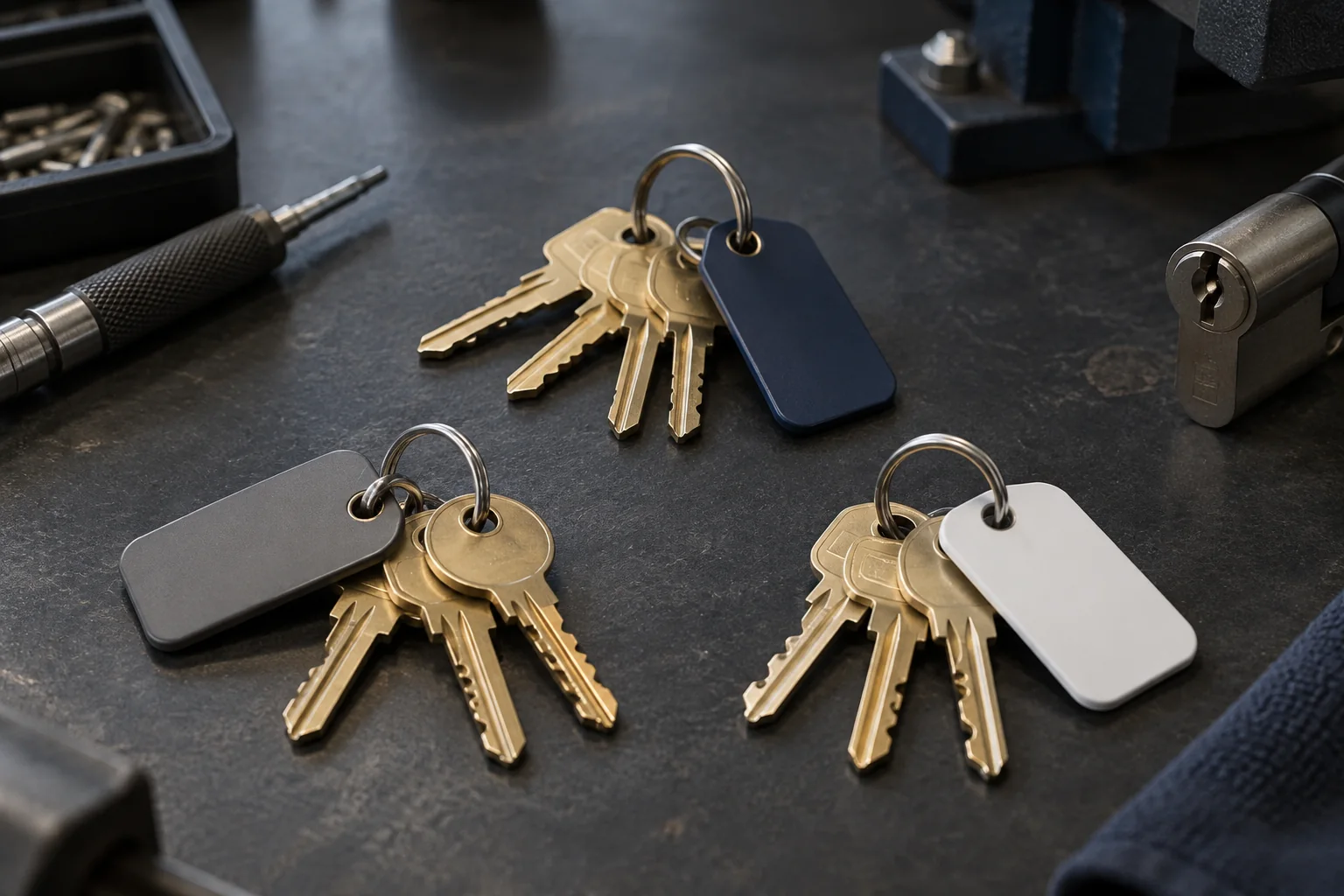
Planning a system.
Bring a floor plan or a door list to the first conversation and the design work moves much faster.
Start a designWhat is the difference between master and restricted?
They answer different questions. Master keying controls which doors a key opens. Restricted keying controls who can get a key copied. They are frequently combined, because a well-structured hierarchy is undermined if any of its keys can be duplicated at a shopping centre kiosk.
Can a master system be added to our existing locks?
Sometimes, where the existing cylinders are of a compatible type and in good order. Often the practical route is retaining the lock bodies and door furniture while changing the cylinders, which is far less invasive and cheaper than replacing complete locksets.
What happens if a master key is lost?
It is serious, because that key opens more than one door. Every lock it operates has to be repinned and those keys reissued. This is exactly why master keys are issued sparingly, signed for, and why sites that expect turnover often put access control on the doors that would otherwise need a master.
Can we expand the system later?
Yes, provided the original chart was designed with headroom. That is the main reason design time is worth paying for. A system charted only for the doors that exist today can run out of usable combinations, and expanding then means rebuilding rather than extending.
How long does an installation take?
It depends on the number of doors and whether hardware is being changed as well as pinned. There is also lead time on cylinders and keys for the system. Installation is normally staged so the site is never left insecure, and a realistic programme is given with the quote.
Should some doors stay off the master?
Often, yes. Server rooms, cash handling, records storage and similar are commonly keyed on their own so they are reachable only by a specific key rather than by anything higher in the hierarchy. Deciding this is part of the design conversation.
What usually sits alongside a master system.
Structure, control and visibility are three separate problems. Most sites need at least two.
Restricted key systems
Stop the hierarchy being undermined by uncontrolled copying.
02Access control
For doors where permissions change often or an entry log is needed.
03Commercial locksmith
The wider site picture: hardware, egress and ongoing maintenance.
04Strata & body corporate
Shared property, where master keying is close to a default requirement.
Tell us what you need secured.
Call for urgent locksmith assistance or send the details of a residential, commercial, automotive or electronic security enquiry.