
Access Control Adelaide.
Decide who opens which door, on which days, between which hours, and change it in seconds. When someone leaves, you delete a credential instead of rekeying a building.
Four parts, on every controlled door.
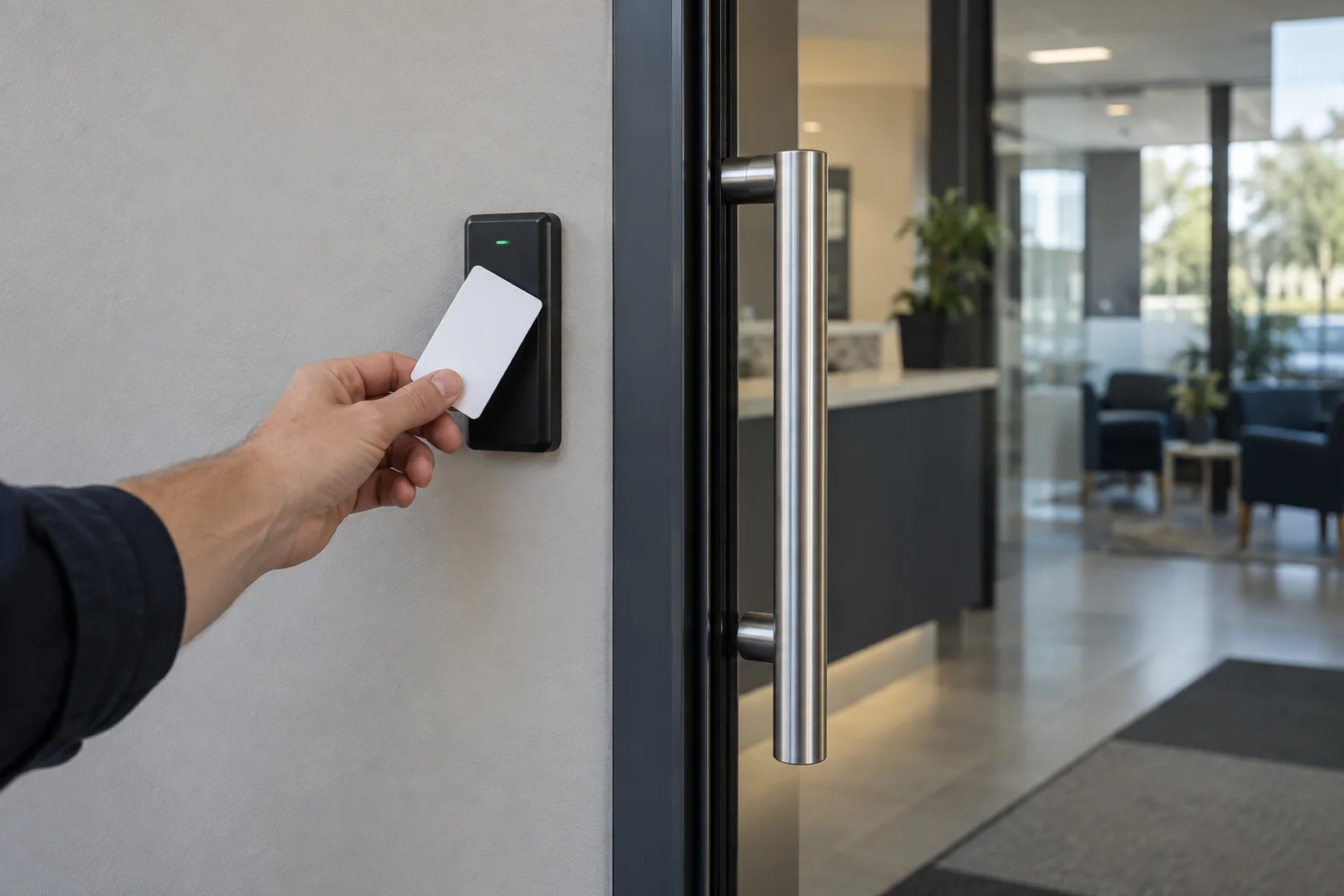
A reader. The thing people present a card, fob or finger to, or type a PIN into. Mounted outside the door.
A locking device. An electric strike, an electromagnetic lock or an electrified lockset. This is what physically holds the door and it is the part that has to be chosen against the door and its egress role.
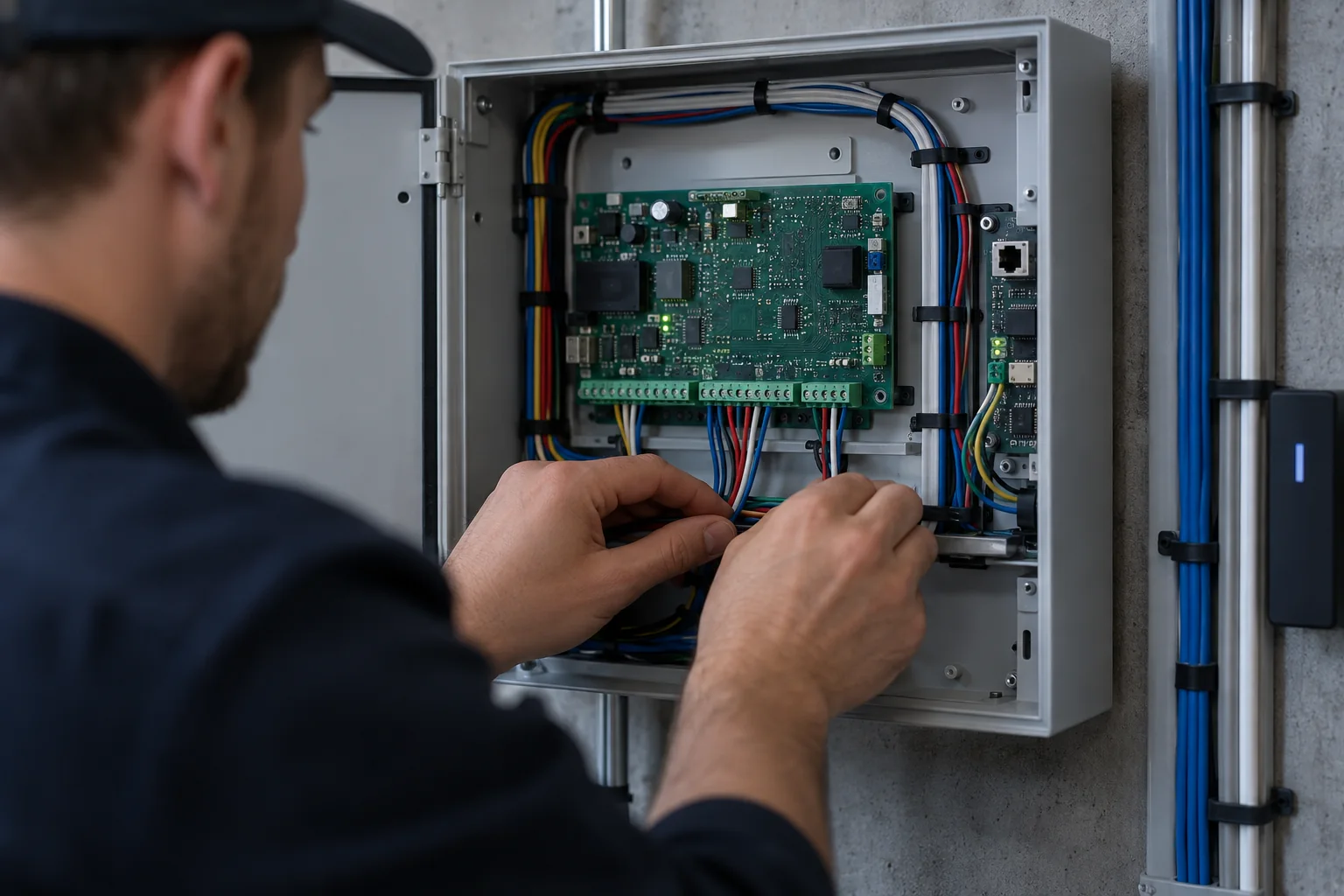
A controller. The decision-maker. It holds the permissions, checks the credential against them and releases the lock, or does not. Good controllers keep working and keep logging if the network drops.
Software. Where you add and remove people, set schedules and read the log. This can be a local application, a browser interface or a hosted service.
The parts people forget
A compliant door also needs a way out. That is usually a request-to-exit device, plus in many cases an emergency release that drops the lock regardless of system state. There is also power, backup power, and cabling to think about.
These are not extras. They are the difference between a system that satisfies its obligations and one that quietly does not.
Card & fob
Simple to issue and cancel. The most common choice for staff.
PIN
No credential to carry or lose. Needs a discipline about sharing.
Biometric
Cannot be handed over or lent. Enrolment and privacy need thought.
Mobile
Credential on a phone. Convenient, and instantly revocable.
Questions worth answering before quoting.
Access control quoted from a door count alone tends to need reworking. These are what actually shape the system.
Any electrically locked door on an escape route must let people out without a credential, and must do so when power fails. Where a door is part of required egress, that obligation determines the locking device, the release hardware and the power design. A system that traps people is not a security system, and we will not install one.
The half of the system nobody sees.
The reader is the visible part. The controller, the strike, the request-to-exit device and the backup power are what decide how the door behaves when something goes wrong.
Practical questions.
A short walk-through of the site answers most of these far better than a spec sheet.
Book a walk-throughHow many doors before it is worth it?
It is driven more by people than doors. A single entry used by thirty staff with regular turnover benefits immediately, because every departure would otherwise be a rekey. Ten doors used by three stable keyholders may not justify it at all.
Does it work if the internet goes down?
A properly specified controller keeps its permissions locally, so doors keep working and events keep being recorded during an outage. The log syncs when the connection returns. This is worth confirming for any system you are quoted, because it is not universal.
Can it be combined with our existing keys?
Yes, and it is the usual arrangement. Electronic control goes on doors where permissions change or logging matters, mechanical keying covers the rest, and controlled doors keep a key override. Many sites run a restricted master key system underneath access control.
What does the audit log actually show?
Which credential was presented, at which door, at what time, and whether it was granted or denied. Note that it records the credential, not the person, so it tells you a card was used, not who was holding it. That distinction matters if the log is ever relied on in a dispute.
Is a fob more secure than a PIN?
They fail differently. A fob can be lost or lent but is individually traceable and instantly cancellable. A PIN cannot be lost but is easily shared, and shared PINs destroy the value of the audit log. For sensitive doors, requiring both is the stronger option.
Can we manage more than one site?
Yes. Multi-site administration from one interface is standard on networked systems, with permissions scoped per site so a local manager sees only their location while head office sees everything.
Systems that work alongside it.
Access control answers who and when. These cover what happened and what holds the door.
CCTV installation
Vision to go with the log, so an event has a picture as well as a timestamp.
02Alarm systems
Detection and alerting for the hours when nobody should be entering at all.
03Master key systems
The mechanical layer beneath, covering doors that do not warrant control.
04Door hardware
Strikes, closers and exit devices: the parts that make a controlled door work.
Tell us what you need secured.
Call for urgent locksmith assistance or send the details of a residential, commercial, automotive or electronic security enquiry.